
On Trust
Building Boys Bulletin 7-20-26
“Most leaders don’t intend to micromanage. They just want to get the job done. Oftentimes, their style gets in the way of their intent…Their micromanagement screams volumes…‘you don’t really trust me.’”
— Stephen M R Covey, author of The Speed of Trust: The One Thing That Changes Everything
I interviewed Stephen last week for an article I’m writing for for the California Association of School Business Officials. He was talking about business, but all I could picture was a 14-year-old boy screaming, “You don’t trust me!” and stomping away when Mom stops by and nitpicks how he’s cleaning the bathroom. Or his room.
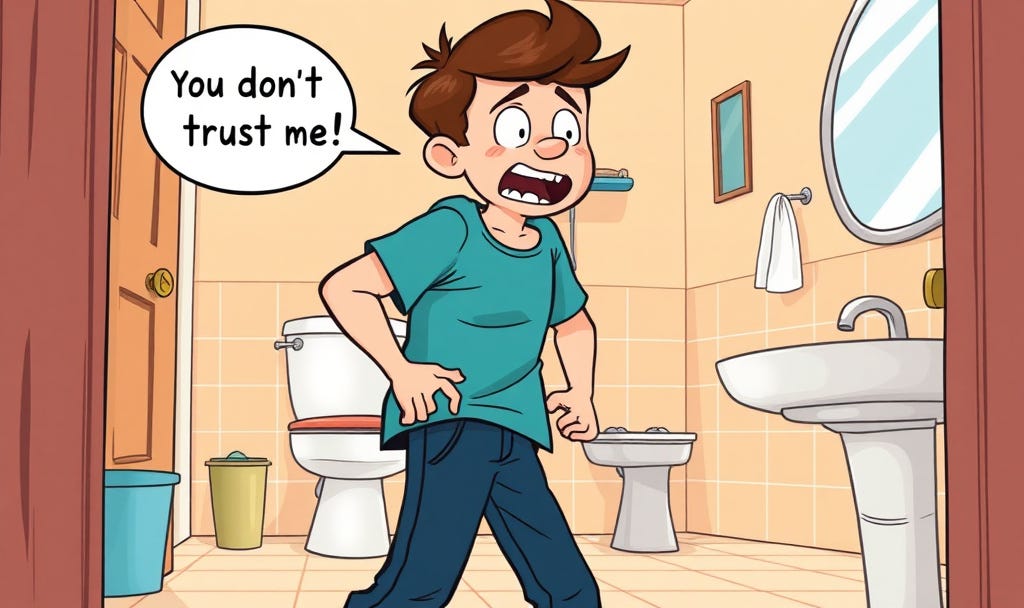
Or comments on his efforts to do better in school. He, perhaps, has told you he’s going to get his math grade up. You see him playing video games AGAIN and, perhaps against your better judgement, say something about it because playing video games after school does not look like “working to improve my math grade” to you.
Sound familiar? Situations like this play out over and over again and are, I think, one of the most common sources of frustration for both teenage boys and their parents.
Teen boys want to be trusted. Their parents want them to do what they’re supposed to do! Parents want to trust their teenage sons to do the right things but they haven’t yet seen it, so they…micromanage and nitpick. Parent and teen go ‘round and ‘round, and instead of increasing trust and capability, there’s an increase is mistrust and disconnection. Before too long, parents and teen alike believe the other is purposefully out to antagonize and harm them.
It’s an unhelpful, unhealthy cycle.
A Better Way
Trust is indeed earned. But it’s also given.
That’s the part many leaders (& parents) miss.
If you want your son (or an employee) to behave in a trustworthy manner, YOU must first behave in a trustworthy manner. Consistently. And over time. You must do what you say and say what you do.
Then, you must extend trust.
That part usually feels a little uncomfortable and scary, especially at first. Because extending trust to another involves risk. When you extend trust to another human, you turn over responsibility for something. You give them the responsibility for a task or project. You may (and should!) discuss the desired outcomes and share any available requirements, resources, and best practices. But then, you give them space and time.
Yes, it might be quicker to tell your son (or new employee) exactly how to complete a task. After all, you’ve likely developed a pretty efficient system for cleaning the bathroom by now.
When you tell someone exactly how to do a task, however, three things happen:
The outcome will never exceed what you yourself could have done. If someone does something exactly the way you would, the outcome, at best, will be the same as if you yourself had done it. More likely, you’ll consider the results subpar because almost no one can (or will) do things exactly as you would.
You rob that other person of the ability to develop their skills and creativity. Humans learn things most effectively when they must. When there’s a gap between what they’ve been asked to do and what they know how to do. We’re a creative species but we tend to only stretch ourselves when circumstances requires us to try something new. That’s when we grow.
You may foster mistrust and learned helplessness. Most people give up if they “get it wrong” every time they try to something. Why keep exerting effort if someone else is just going to do (or re-do) the task anyway?
Over the long run, the “quicker” approach leads to poor morale and under-developed skills, while the seemingly-slower-and-riskier approach of extending trust and giving the other person the time, space, and support necessary to figure things out leads to far better outcomes.
“There’s a speed to trust,” Stephen told me. When you don’t trust others (in your workplace or in your family), “ you don't move as fast because people are waiting for the orders; they're waiting to be told what to do. And they haven't developed their initiative… or their creativity,” he said.
As uncomfortable as it may be sometimes, we have to trust our boys. We have to extend trust. Give them responsibility. Let them make decisions, experience consequences, and learn from them.
Trust Doesn't Mean Certainty
Many parents think trust means believing your son will do the right things. Make the right decisions.
“I’ll trust my son,” they say, “when he’s shown me I can trust him.”
But trust doesn’t work that way. People grow into trust. And if we only extend trust when we’re certain our boys will succeed…well, our boys will have mighty few opportunities to grow.
It’s a bit ironic, actually, that this conversation came just a few days after I discovered a Building Boys book review suggesting I may have fabricated some of the stories about my boys:
I’m to believe she really stood by and let her son buy a used car off of a stranger on the internet and that she then stood by and watched him in defeat when it was a pile of junk that didn’t run, to finally stand by and watch him figure out how to resell his pile of junk for half of the money he spent on it? I fully believe in letting kids make mistakes to learn from them, but that just feels like some negligent parenting.
Uh, yes. Yes, I did stand by and let my then-15-year-old son buy a car that turned out to be clunker. (As I wrote in the first few paragraph of Chapter 4, “Reader, if you’re thinking, this is a bad idea…I thought so too.”) I “let” him do it for three reasons:
He was a teenager. Trying to stop a teen from doing something they really want to do usually leads to said teen finding a way to do the thing behind your back.
It was his money.
I trusted.
I didn’t trust that my son would make the same decision an experienced adult would make. I trusted him, broadly, because I’d done so before and he’d demonstrated a reasonable awareness of safety. (He was bringing an older friend with him and meeting the seller in a public place). I also trusted that he’d learn something. No matter what happened with the car, I knew he’d learn something.
He did. Within a few days, he learned that it’d cost more than he paid to fix the car. So then he learned how to sell a car. How to more carefully vet used car purchases. And, perhaps most importantly, that I trusted him to make decisions and solve problems.
THAT’s the speed of trust.
That 15-year-boy is now a 23-year-old man. He’s bought and sold many vehicles. Earned a certificate in automotive technology. Is the head of equipment maintenance a landscaping company. Bought (and paid off) a brand new car. And currently owns two non-functioning cars of the same model that he plans to rebuild into one cool functioning car.
More importantly, HE trusts that he can handle problems.
When our boys know we trust them, they gradually begin to trust themselves. And that's when they stop waiting to be told what to do and start becoming capable men.
Here’s to building boys!
Jen
IN THE NEWS
Lost Boys: From Boy to Man (full report here)
Highlights:
“We still too often fail to recognise the quirks, contributions, and positive attributes of young men. At best, this leads us to misunderstand them; at worst, it leads us to demonising them.”
“We have told boys what not to be, and not what they should become…We have too long let young men to find their own way through a culture that gives them endless stimulation, but very little direction.”
“Disengaged boys that we have spoken with are not lacking in ambition. Rather, they lack a clear line of sight between what they are doing now and what adulthood could look like”
“Biological denialism is just as dangerous as biological essentialism. Boys will be boys because it is what they are.”
“The Success Sequence… gives boys a vision of what their future could look like and how they can achieve it, with the importance of work and stable relationships embedded within it.”
Highlights:
“Because our son was absent from the digital platforms where his peers were socializing, he became structurally distanced from his friend group.”
“I find myself sitting at my kitchen island, flooded with modern mom guilt, wondering: Did I ruin his social development by attempting to protect him?”
“When local team sports or scouts failed to resonate with our son, we shifted horizons and enrolled him in a specialized science camp at UC Berkeley. Witnessing him interact with peers who shared his precise intellectual passions completely transformed his self-concept”
The Social Media Ban Sceptic: Are We Getting it Wrong on Kids, Tech, & Mental Health?
Highlights:
“She thinks politicians and parents are worrying about the wrong things when they point to social media as the primary explanation for a growing mental health crisis among young people.”
“Social media, she argues, is ‘one of the least influential factors’ in teen depression and anxiety”
“The more we make [social media] a forbidden place to spend time, the less likely they are going to tell us what’s happening in those spaces, the less likely they will be to report harms, the less likely we will be to help them.”
“The culture of blaming parents who allow their children time on devices is also unhelpful.”
When the Male Gaze Turns on Men
Highlights:
“A generation ago, the typical straight man projected indifference about his appearance… Now a straight man’s appearance seems to be an increasingly important expression of his masculinity.”
“As in all online communities, it is hard to separate performance from sincerity. But behind language like “mogging” and dubious practices like “bone smashing” is the real anxiety of boys who are insecure about the width of their shoulders or the prominence of their jawlines.”
This is both very true and very hard.
With the older (16) I've been using "What is your plan for X?" The answer insures me that there IS a plan (for my peace of mind), and forces him to both have a plan and articulate it. I normally follow up with questions like "do you need any support from me?" and/or "Can I check back at X time or on Y date to make sure everything is on track?" ...results are mixed, but it's way better than micromanaging, which goes 100% against the grain for me, and he hates...
The younger one (10) gets a written list of tasks than must be done before a certain time (dinner, basketball practice, leaving for school) or reward (normally screen-time). He can do anything else he wants before/during the time he's working through the list (including just stare into space, which he can do for a shockingly long time...), but it has to be finished before the deadline arrives or reward is available. Again, not perfect, but way better than nagging...
The line that trust is earned but also given is the whole thing. I run group mentoring for boys at KB Foundation in Philadelphia, and I watch this exact cycle with parents and with new mentors. The boys who grow fastest are the ones an adult trusted slightly before they had proven it. The car story is not negligent parenting, it is the most efficient teacher your son could have hired, and it cost him half a used car.